


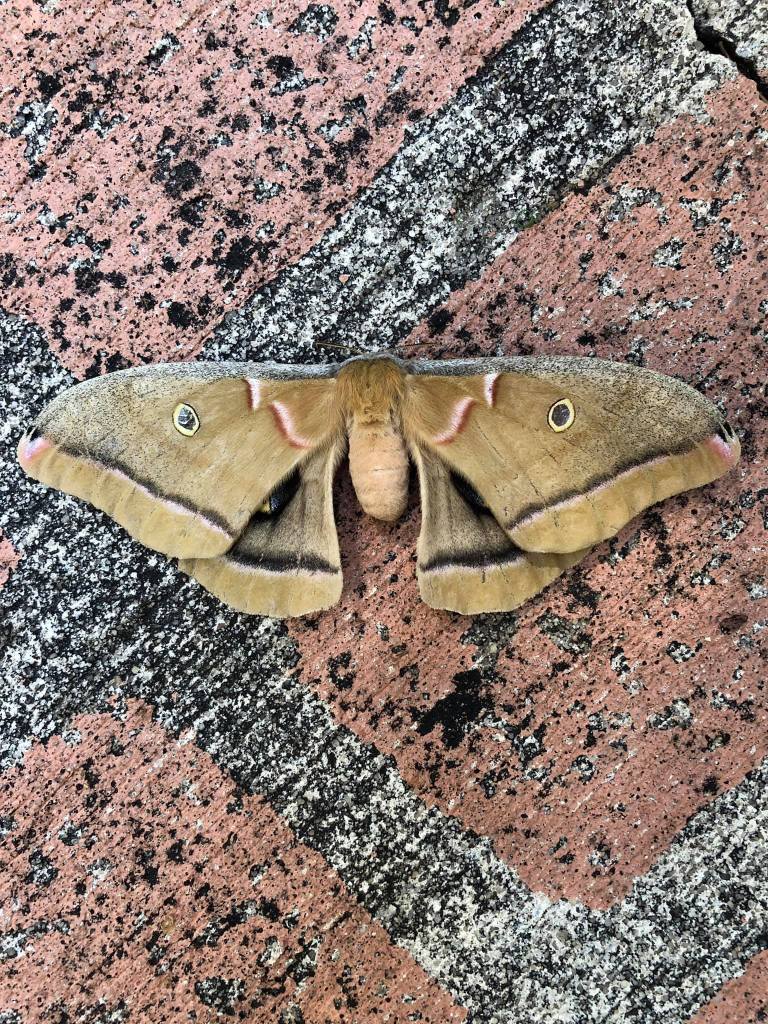
I saw what looked like a small bird flapping on the outdoor table, and on closer inspection, discovered it was a giant brown moth with two black circles on its back like eyes. A quick Google search let me know this was a Polyphemus moth (Antheraea polyphemus) and it is one of the largest moths in North America.
My fearless son immediately wanted to try and hold it, and as he put out his hands, it landed right in them for a moment.

The Antheraea Polyphemus Moth
The moth is named after Polyphemus the Cyclops, a one-eyed giant encountered by Odysseus in Homer’s epic, the Odyssey. Although this giant has two “eyes,” it’s still aptly named after this mythological figure.
The Polyphemus moth is renowned for its wingspan, which can reach up to six inches. Its wings are a canvas of rich earthy tones, adorned with striking patterns and hues of brown, beige, and pink. However, its most distinguishing feature is the conspicuous eyespots on its hindwings.
These eye spots function as a clever defense mechanism, deceiving potential predators into perceiving a far greater threat than just a mere moth. In moments of peril, the moth adeptly flashes its hindwings, crafting the illusion of numerous eyes glaring back at the predator.
Life Cycle of the Polyphemus Moth
Like all moths, the Polyphemus moth undergoes a remarkable transformation known as metamorphosis. The journey begins when a female moth lays her eggs on the leaves of host plants such as oak, birch, or maple. From these tiny eggs hatch voracious caterpillars, whose sole mission is to devour foliage and grow.
As the caterpillar grows, it sheds its skin several times in a process called molting. Eventually, after several weeks of feasting, the caterpillar retreats into a cocoon spun from silk and leaves. Inside this protective casing, it undergoes a miraculous metamorphosis, emerging weeks later as a fully formed adult moth, ready to take flight.
Ecological Importance
Beyond its aesthetic allure, the Polyphemus moth plays a vital role in its ecosystem. As both caterpillars and adults, they serve as a food source for predators such as birds, bats, and rodents, thus contributing to the intricate web of life. Additionally, their caterpillars help to regulate plant populations by consuming foliage, thereby influencing forest dynamics.
Conservation Concerns
Despite its grandeur, the Polyphemus moth faces threats to its survival. Habitat loss, pesticide use, and light pollution all pose significant challenges to its populations. Conservation efforts aimed at preserving natural habitats and raising awareness about the importance of biodiversity are essential in safeguarding the future of this magnificent creature.
We’ve only seen the moths twice here in Atlantic Beach, and both times they were pretty amazing to see in person!
Discover more from Keane & Coastal
Subscribe to get the latest posts sent to your email.
 Keane & Coastal
One thought on “What is that Giant Brown Moth?”